Showing posts with label Birding. Show all posts

Monday, June 6, 2011

Bird Banding at CNC

A Common Yellowthroat warbler gets banded
at the CNC Wetlands Area. 
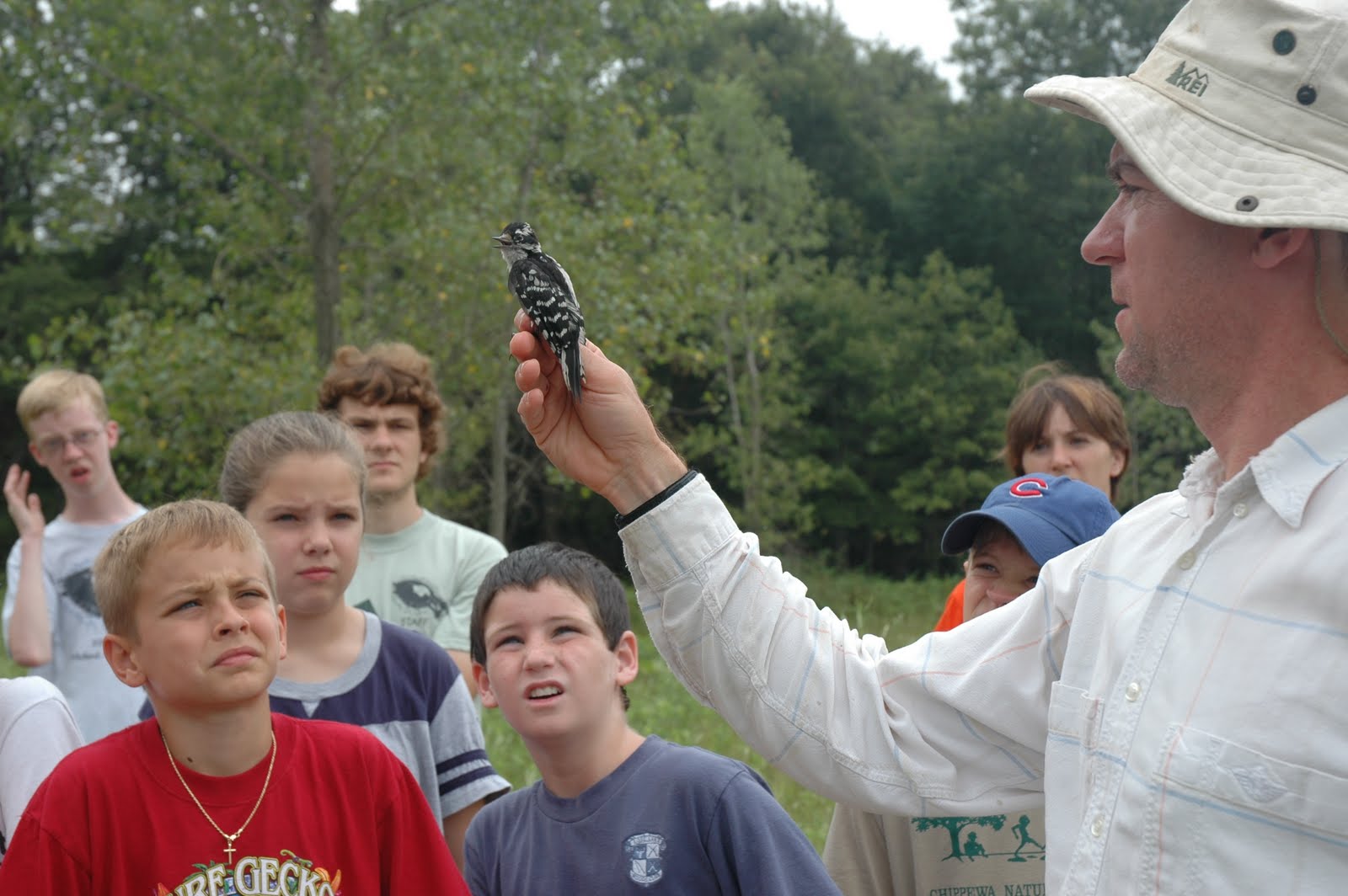
This year marks the 8th season of bird banding research at the Chippewa Nature Center Wetlands Area. The project is headed by Mike Bishop, professor of biology and ornithology at Alma College in Alma, Michigan. From year-to-year, the data he gathers gives us clues to the overall health of different species that live at CNC. Mike’s research follows the protocol of the national “MAPS” program (Monitoring Avian Productivity and Survivorship). A Nature Center staff member will also be on hand to help answer your questions and identify birds and other animals that are swimming in the ponds or flying by.
Mike Bishop demonstrates banding a
Downy Woodpecker to CNC Day Campers.

Visitors are welcome to observe banding from 8am-Noon on days which Mike is here banding birds. During this time, you'll hear facts such as the species, sex and age of the birds and have the opportunity to ask questions. Bring your camera, as you'll have excellent opportunities for photography!

For a full list of banding dates this year, check out our webpage calender here. If rain or windy weather is threating, please check the website, our Facebook page or give us a call for updated schedule information.

Monday, May 9, 2011

Leelanau BirdFest: June 1-5, 2011

Though many people are aware of the Traverse City area's fame for cherries, wineries, lighthouses and spectacular sand dunes, the first annual Leelanau BirdFest is another great reason to visit the area this spring. Held from June 1-5, the event promises to "offer a wide variety of unique field trips including Birding by Tallship, endangered Great Lakes Piping Plovers, a 300 acre prairie, and pontoon boat to the Leelanau Conservancy’s Cedar River Preserve.  Every field trip, seminar and keynote program reflects our conservation theme." 

The event is sponsored by a diverse group of organizations including the Leelanau Chamber of Commerce, Sleeping Bear Dunes National Lakeshore, Michigan Audubon Society, Leelanau County Parks and Recreation and many more.

Birding highlights in the area include nesting Piping Plover (a federally-listed endangered species), nesting Prairie Warblers, and a wide variety of field species, such as Grasshopper and Vesper Sparrows, in areas of preserved farmland. For more info, you can print a checklist of birds found at Sleeping Bear Dunes National Lakeshore by clicking here.

To find a full schedule of information and to register for the BirdFest, visit their website.

Monday, May 2, 2011

Choosing the Right Field Guide

Let's say you want to get started in birding so you head out to the local bookstore. With so many field guides out there, it can be a daunting task to figure out which one will work best for you outdoors! While choosing a field guide has a lot to do with personal preference, here are a few things to look for as you decide what’s right for you.

Narrow the focus
If you do most of your birding close to home, choose a guide that specializes on your area of the country. Books that cover all of North America can get confusing.

Pictures or drawings?
A photograph gives you a sample of a real-life bird in the wild, but drawings
may capture variations in plumage better.

Organization
A guide that presents bird species by family (ducks, warblers, etc.) is easier to use than
one that organizes birds by color or size.

Our top picks
Guides preferred by CNC staff are The Sibley’s Field Guide to Birds of Eastern North America by David Allen Sibley and Birds of Eastern and Central North America by Roger Tory Peterson.

You'll find a great selection of field guides right here at the Chippewa Nature Center store!

Monday, April 18, 2011

Choosing the Right Binoculars


Spring is a great time of year to grab your camera or a  pair of binoculars and head outdoors to enjoy the natural beauty that is appearing all around us every day.

When choosing binoculars consider how well they fit your hands, eyes and of course, pocketbook. Numbers such as “8X42,” refer to the magnification (first number) and field of view (second number), or how much area can be seen. To choose the best ones for you, "field-test” binoculars indoors first by looking at small type on distant signs, items of similar color, and poorly-lit areas. Ask yourself “field” questions, such as: Do they fit your hands? Are they light enough to hold up to your eyes for a while? Can you focus quickly, and on something nearby, or only on distant objects?

There are many great articles and reviews online with expert advice to help you choose the best pair for your needs. For more information, check out this review at Bird Watcher's Digest or feel free to call a Chippewa Nature Center Naturalist at (989) 631-0830.

Monday, March 28, 2011

drive on the wild side

Bald Eagle
photo by Kim LeBlanc
STOP THE PRESSES!  The refuge just announced that the auto drive described below will NOT open April 15, because a pair of Bald Eagles are building a nest along the route.  If they continue to use that nest, it might be mid-June before the route opens.  But since eagles often build "practice" nests, the route might yet be opened in early May.  Stay tuned! 

The Shiawassee National Wildlife Refuge has over 9,000 acres, but most of it has been accessible only by foot or bike, or not at all (the better to maintain it as a "refuge" for wildlife!).  But this year that changes, as a 7.5-mile auto tour opens in April. (http://www.fws.gov/midwest/Shiawassee/)

The auto route will be open 7 a.m. - 7 p.m. from April 15 - October 5, barring flooding conditions or soft roads.  And since four rivers come together at Shiawassee, take that "except when flooding" clause seriously!  To be certain of conditions, it's a good idea to call the refuge headquarters, (989) 777-5930, ahead of time. Another complication could be one of the more popular critters at Shiawassee -- the Bald Eagle.  If eagles choose to nest alongside the driving route, the opening date would have to be postponed until the young eagles leave the nest.

The route will provide wonderful access to the forests, floodplains, wet meadows, cattail marshes and rivers of Shiawassee, and its incredibly diverse wildlife.  People driving the route will be asked to remain in their cars, except at designated viewing areas, in order to limit their impact on birds and other wildlife. (Cars make great wildlife blinds!)


Check out Janet Martineau's
blog for more information
on the auto route at Shiawassee
 For more information about the auto route, check out this blog by "Friends of the Shiawassee" member, Janet Martineau,  http://janetmartineau.blogspot.com/2011/01/shiawassee-national-wildlife-refuges-75.html.
If you haven't visited this refuge before, you are in for a treat!  Over 270 species of birds use the refuge, including thousands of waterfowl during spring and fall migrations.  The refuge has been designated as a U.S. Important Bird Area by the American Birding Association. Prothonotary warblers, rails, shorebirds, nesting Bald Eagles. . . every season brings a variety of sightings!


Wednesday, February 9, 2011

The Great Backyard Bird Count

If you love birds, you're invited to join thousands of other birders in the Great Backyard Bird Count (GBBC), held this year from February 18-21. The Great Backyard Bird Count is a joint project of the National Audubon Society and the Cornell Lab of Ornithology with Canadian partner Bird Studies Canada. This four-day event is open to bird watchers of all ages and provides information about more than 600 bird species. “There’s simply no better way to collect information about all these birds so quickly across such a large range,” said Janis Dickinson, Citizen Science director at the Cornell Lab.From reports of rare species to large-scale tracking of bird movements, the GBBC provides insight into the lives of bird populations.

In 2010, the GBBC had a record-breaking year for participation as more than 97,200 bird checklists were submitted by an estimated 63,000 volunteer bird watchers from across the United States and Canada. To participate, you just have to spend at least 15 minutes counting birds on one day of the count. When you're done counting, you simply enter your data on the GBBC webpage.

For full details, visit http://www.birdsource.org/gbbc/howto.html. 

Monday, January 31, 2011

Visions of Winter

As we close out the first month of the New Year, enjoy these scenes of winter, all taken at Chippewa Nature Center. Better yet, check out our program calendar and join us for a snowshoe hike, bird walk or other adventure on and off the trails at CNC!

Our "famous" Red Oak near the Maple Sugarhouse.

If you can't come see a view in person, check out our webcam,
which hangs directly below the River Overlook.

White Pine cone

Snowy Fungi

A Black-capped Chickadee searches for seeds in the snow

A Gray Squirrel (black phase) trying to keep warm under its tail

Sunshine through snowy branches

Monday, December 13, 2010

Christmas Bird Count - Volunteers Needed!

The Audubon Society's Frank Chapman proposed the first "Christmas Bird Census" on December 25, 1900. For the past 110 years, Christmas Counts have become a major factor in tracking the health of bird populations across North America. Why not become a "Citizen Scientist" and get involved this year? 


Snowy Owl

With Christmas Bird Counts in Midland and Bay City fast approaching, we are looking for volunteer counters to help out. To sign up as a volunteer for the Midland or Bay City count (or both), please contact the following:


Bay City Count: December 18
Contact Jeanne Henderson: (989) 684-3841

Midland Count: January 2
Contact Audrey Diadiun at (989) 832-9546


This is 111th year of the Christmas count and we are looking keep this tradition alive and well in the Great Lakes Bay Region. You don't have to be an expert birder or have prior experience with bird surveys. All helpers are welcome!


Monday, September 13, 2010

Fall Migration Bird Banding Weekend

Banding birds at the Chippewa Nature Center Wetlands Area helps us understand our feathered friends who share the land we now own. From year to year, data also give us clues to the health of different species. Our banding program is run by Mike Bishop of the Alma College Biology Department. Mike also runs a banding station for Alma College at Vestaburg Bog. You can learn about activities at both stations by checking out this excellent blog, which contains information and pictures from both sites.


Your last chance to catch Mike and his ornithology students in action at CNC this year will be this Friday, September 17th from 4:00pm-dark and Saturday September 18th, from 8am-2:00pm. The parking lot is on the west side of the Wetlands off Grey Road and the gate will be open during banding hours. We hope to see you there!


For up-to-date information about all CNC programs, visit the program calendar on our website.

Tuesday, June 15, 2010

Olivia the Artist (age 11) helps oil spill efforts

Olivia wants to attend Cornell to become an ornithologists some day. For now, her paintings are helping raise money to help oil spill cleanup efforts. See her story in this video and learn more by visiting HERE.

Monday, May 31, 2010

Join the Funky Nests Challenge!

Ithaca, NY—The Celebrate Urban Birds project at the Cornell Lab of Ornithology is bringing back its "Funky Nests in Funky Places" environmental challenge! Participants sent in more than 600 entries last year. They found nests in hanging flower baskets, an old boot, a teacup, a coffee can--even on top of a clothespin, where a hummingbird built its tiny nest. Celebrate Urban Birds is a free, year-round citizen-science project from the Cornell Lab of Ornithology, focused on birds in neighborhood settings.
For the 2010 Funky Nests in Funky Places challenge, participants may take photos, do a painting, write a story, or shoot a video showing a bird’s nest built in some out-of-the-way or out-of-this-world place.
Photo by Jacquie Tinker, New York
“We've had such fun with this challenge,” says project leader Karen Purcell. “The theme really struck a chord with people. You wouldn't believe how many people showed us bird nests in barbecue grills, bathrooms, garden tools, and signs. We even had Tree Swallows nesting in a cannon!”

Prizes include Kaytee bird feeders and seed, sound CDs, books, Cornell Lab gift baskets, nest boxes, and more. The first 50 entrants will receive a copy of the "Doves and Pigeons" poster by Julie Zickefoose and selected images and videos will be posted on the Celebrate Urban Birds website. We'll also be creating a 2011 calendar using some of the best entries.

Email your entry to urbanbirds@cornell.edu:
 
1. Write "Funky Nests_Your First and Last Name_ Your City and State" in the subject line.
2. In the email, you MUST include your name, mailing address, and location where photos were taken.
3. Tell us why you submitted your entry to the Funky Nests in Funky Places contest.
4. Choose your best/favorite entry and send just that one, please! 
5. Read the terms of agreement
6. Be careful around nesting birds. Read more about how to find nests and what to do once you know where birds are nesting.
7. If you agree to the terms above, send us your entry before July 1, 2010. 

Visit the Celebrate Urban Birds website for more information.
 The 2010 Funky Nests in Funky Places challenge is sponsored in part by Kaytee.
#
Project Contact: Karen Purcell, Project Leader, (607) 254-2455, urbanbirds@cornell.edu
Media Contact: Pat Leonard, (607) 254-2137, pel27@cornell.edu
______________________________________________________________________

The Cornell Lab of Ornithology is a membership institution dedicated to interpreting and conserving the earth’s biological diversity through research, education, and citizen science focused on birds. Visit the Cornell Lab’s web site at http://www.birds.cornell.edu.

Monday, May 3, 2010

Where are the Nightjars?

Whip-poor-wills and other members of the "nightjar" family have been in serious decline for several decades.  Now, a volunteer-supported research effort is being coordinated by the Center for Conservation Biology to try to develop a nationwide survey that will provide baseline information on nightjar populations. 

Volunteers are needed in 38 states (including Michigan) to spend a couple of hours doing a once-a-year survey along pre-determined routes.  The 9-mile-long routes have 10 stopping points, where volunteers will stop and listen for the calls of the birds.  In Michigan, the survey period is June 19 - July 4.  If you would like to adopt one of these survey routes, check out this website for more information:  http://www.ccb-wm.org/nightjars.htm

Photo: Common Nighthawk. Image from Wikimedia Commons. 

Monday, March 15, 2010

Web Cam Fun

One of the many benefits of modern technology is that it can get us up close views of animals in the wild without thousands of people tromping up to disturb their natural habitat. A good example earlier this winter is the webcam of Lily the Black Bear near Ely, Minnesota. Thanks to the North American Bear Center, thousands of people all over the world are able to peer into her den as she cares for a single cub somewhere in the wilds of northern Minnesota. You can check it out by clicking here.


Other websites can give you up close looks of birds sitting on their nests. The one featured here features a great view of a Bald Eagle on its nest!  The nest is located in the Norfolk Botanical Gardens in Norfolk, Virginia. Eggs were laid January 31, so there should be eaglets to watch by mid-March!  Enjoy the show!

Monday, February 8, 2010

Great Backyard Bird Count Feb. 12-15

The 13th Annual Great Backyard Bird Count is coming! Your chance to count for fun and count for the future comes from Friday, February 12, through Monday, February 15. Whether you participate once or several times, by submitting your list of the birds you see at http://www.birdcount.org/ you will help scientists learn more about how birds are faring in your neighborhood.

The count has been a joint project of the Audubon Society and the Cornell Lab of Ornithology for many ears. This year, they are delighted to welcome Bird Studies Canada (BSC) as the first international partner. “Bird Studies Canada is delighted to be the Canadian partner for this extremely valuable program,” said George Finney, President of BSC. “Participating in the GBBC is an excellent way for Canadians to reconnect with their love of nature and birds.”

Help Make this the Biggest GBBC Ever!
The more people who participate in the GBBC, the better the information scientists will have about how bird populations may be changing over time due to habitat loss, climate change, disease, or other factors. To take part, just check out details at the Great Backyard Bird Count website and this Friday, start counting!

Monday, January 11, 2010

Brush Piles for Wildlife

Brush piles have a reputation in some circles as "waste piles," the sign of the Lazy Man who refuses to keep things tidy. But in wildlife circles, they have a much different status. A well-built brush pile is a nesting spot for Northern Cardinals, Song Sparrows and Gray Catbirds. It's shelter for migrating White-throated Sparrows and overwintering Northen Juncos, as well as resident rabbits, grouse and chipmunks. And it is an emergency bomb shelter when a hawk enters the vicinity. So this holiday season, consider giving wildlife a homemade gift - a brush pile!

So how does one built the neighborhood's BEST brush pile? A good shelter has a dry basement, so start with a dry spot, or build up the site a bit before beginning. If there is standing water under the pile, it is of less value to the animals you are building for.

The bottom "floor" should be logs or sizeable branches of leg thickness or greater. This is the foundation, the ultimate factor determining width and length, so plan accordingly. Place the foundation logs parallel to each other, with a foot or two in between (the better for chipmunks, weasels and rabbits to scurry through), then place another layer of similar size on top of these, running in the opposite direction. Layer #3 should be smaller branches, placed thickly enough to catch grass clippings from above but loose enough to provide ventilation.

From this point up, the brush pile is whatever you make it, using whatever "stuff" is available -- straw from the dog pen, branches trimmed from shrubs, grass clippings, fallen branches. All that really matters is that there are alternating layers of loose material (such as branches of various sizes) and more solid material (straw, grass clippings). Solid layers capture fallen seeds and provide insulation, while the open layers allow for ventilation, as well as easeir movement through the pile for those who live there.

If the appearance of the brush pile is a concern, or you want to provide a two-for-one deal for animals (shelter AND food), decorate the brush pile with Wild Grape, Virginia Creeper or other vines to provide a splash of fall color, seeds and berries. As will all really good gifts, a brush pile will bring pleasure to both those that use it, and the one who sees how much it is appreciated.
 - Janea Little, Senior Naturalist

Monday, December 7, 2009

Christmas Bird Count - Volunteers Needed!

The Audubon Society's Frank Chapman proposed the first "Christmas Bird Census" on December 25, 1900. For the past 109 years, Christmas Counts have become a major factor in tracking the health of bird populations across North America. Why not become a "Citizen Scientist" and get involved this year?

With Christmas Bird Counts in Midland and Bay City fast approaching, we are looking for volunteer counters, as well as a new compiler for the Midland count. We would also like to thank Dr. Gene Beckham for his years of compiling the Midland event and assisting with other counts.

To sign up as a volunteer for the Midland or Bay City count (or both), please contact the following:

Bay City Count: Dec. 19
Jeanne Henderson at 989.684.3641

Midland Count: Dec. 20
Dr. Gene Beckham at 989.631.4927

This is 110th year of the Christmas count and we are looking keep this tradition alive and well in the Great Lakes Bay Region. You don't have to be an expert birder or have prior experience with bird surveys. All helpers are welcome!

Monday, October 5, 2009

Map-Free Travel

Most people stop and check a map when they take a long trip, or even on a short trip into a new area. You first double-check that you are where you think you are, then look at the route ahead to see what to expect in terms of route changes, distances, and obstacles.

In comparison, the map-free travel plans of birds have long been a mystery. How do they know where they are going, how far to go, or what route to take? Year after year, ornithologists have answered many questions about how birds get oriented.

They have learned birds use stars to navigate by. They have learned that birds have a built-in compass to orient by the magnetic poles of the planet, although they can’t tell magnetic north from south. (A very significant point for long-distance migrants that cross the equator.) And they know that birds can see polarized light, which enables them to orient by the position of the sun even on a fairly cloudy day.

In 2004, another piece of the migratory puzzle was solved. A team of scientists from the Illinois Natural History Survey, Princeton University, and Germany’s Oldenburg University, followed a series of Swainson’s and Gray-cheeked Thrushes that were tagged with radio transmitters and released at sunset for their nocturnal migratory flight. Some of the birds were simply “tagged” and released, while others were first exposed to artificial magnetic fields that were “off” by 80 degrees.

Control birds, as expected, flew due north when released. The birds whose magnetic “readings” had been skewed flew west for the first night, then rested during the day. The next evening, however, the control birds all corrected their course and headed north.

So what does it mean? Apparently birds are able to calibrate their internal compass using the location of the sun, and probably do so every evening before they take flight. It’s a significant factor for those long-distance migrants, who can re-orient after crossing the equator. Question #312 answered, two-and-a-half million to go!

-Janea Little, Senior Naturalist

Tuesday, April 7, 2009

Nest Boxes Now

Many species of birds choose holes in trees as their favorite spots to build nests. As old, dying trees are cut down in our neighborhoods, fewer of these cozy nesting cavities are available for our avian friends. These days, many bird species are under major stress and need our help. Habitat loss, climate change, window kills, and other hazards have led to dramatic changes in bird populations in the past 40 years. The State of the Birds Report, released by Secretary of the Interior Ken Salazar in March, warns that fully 1/3 of the 800+ bird species in the U.S. are in trouble. It states "Among these species, 67 are federally listed as endangered or threatened. An additional 184 are species of conservation concern because of their small distribution, high threats, or declining populations. Nest boxes are a great way to attract birds to your backyard habitat. Depending on where you live, birds such as Chickadees, House Wrens, Tree Swallows, Nuthatches, Bluebirds, House Finches and even Screech Owls might take up residence. Different species prefer certain size holes and boxes, so be sure to check the specs before you build. Some birds, such as a Robins, Phoebes and Barn Swallows prefer a nest shelf instead of a box. Click Here for plans. And you can build your own predator-resistant bluebird box with these plans from Chippewa Nature Center. Questions? Just contact us here.