Monday, October 10, 2011

Enjoy Our Archive

Chippewa Nature Center launched this blog on March 4, 2009 to share tips for a greener lifestyle in a world where such information was scattered and hard to come by. Over the past two and a half years, access to such information has exploded across the web and many excellent resources are now available for easy access to information. A few choices include The Daily Green, The Queen of Green and National Geographic's Green Guide.  

Instead of continually trying to "reinvent the wheel", we've decided to let this blog sit in "archive mode" for a while as we assess how we can best use this format to connect with our readers. We've found that a huge majority of our online friends prefer our Facebook page, where daily program updates, trail conditions, photographs, and more are shared not only by CNC staff, but by YOU as well. That, we feel, is the best of all circumstances, when you are asking questions, sharing discoveries and interacting with us and each other. 

In that spirit, we hope you enjoy perusing the archive of articles and links on live green...naturally and check out our trail map and other information here. For up-to-date information, trail conditions, photo sharing, and to ask a question of CNC staff, please visit our Facebook page at http://www.facebook.com/cncmidland

For the most complete source of information about Chippewa Nature Center, visit our Home Page at http://www.chippewanaturecenter.org. Here, you'll find a  yearly program calendar, information about  facilities, hours, directions, newsletters, checklists, affiliate groups, and MUCH more! 

As always, if you have a question, comment or concern, please feel free to give us a call at 989.631.0830 or stop by the Visitor Center and chat with us in person. Our facilities are open year round, seven days a week and are free to the public. 

Visitor Center Hours: 8am-5pm (M-F), 9am-5pm (Sat), 1-5pm (Sun) 
Building closed Thanksgiving & Christmas Day.

Trails open dawn-to-dark every day
No pets, please

Many thanks to all of you who make Chippewa Nature Center a part of your lives. We hope to see you on the trail, on the river, and in the Visitor Center as you Venture Out into the wonderful world of nature!


Monday, September 26, 2011

Fun Fall Fungi

Autumn is here and the woods are alive with migrating birds, squirrels fattening up and the changing leaves of trees. It's also the season on amazing fungi, which fruit this time of year, spurred on by rain showers. As you take your next fall color walk at Chippewa Nature Center, don't forget to look down and enjoy these amazing residents of the forest floor. To learn more about amazing fungi, sign up for our weekend workshop, scheduled for October 7-9. For more details, visit http://www.chippewanaturecenter.org/cal_oct11.htm. Don't delay, the registration deadline is September 30th! 


Wednesday, August 17, 2011

The Chicory Coffee Capitol of America

Take a drive through the Michigan countryside in August and you're likely to see pretty blue flowers in full bloom growing in the gravel alonside the road. As you might imagine, this "weed" was first brought to the U.S. on purpose, like many other common flowers we now find in our yards, fields and ditches (i.e. dandelion, mullein, purple loosestrife, etc.)

This lovely lavender blossom is of a plant known as Chicory, originally a native of Europe, which was brought to the United States as a coffee substitute and medicinal potherb. Chicory coffee? Down at the local coffee shop today, you'll have to choose between coffee beans grown in Columbia or Costa Rica, Kenya or Guatamala, Mexico or Peru. Ask for a cup of chicory root and you'll probably have a pretty confused waiter!

But once Midland, Michigan was known as the "Center of America's Chicory Field." Roasted and ground chicory roots were first used as a coffee substitute in Germany in the 1770s, though it has been grown as a medicinal herb for roughly 5,000 years. The Coffee Book, by Dawn Campbell and Judith Smith states: "Kaffee Ersatz was much in use during WWI and II when coffee was hard to come by and not affordable. Chicory's ability to blend well with coffee, tea leaves, or herbs has long been known."

In 1926, a local newspaper bragged about Midland County's place in the chicory-growing industry in its book, The Midland Sun, Second Development Edition. It said: "Few people, even in Midland, realize that all the chicory used in the entire United States is raised in Michigan, in fact, in Midland county and tributary territory. Formerly vast quantities of this root, which is used so extensively...as an addition to coffee, was not grown profitably anywhere in the United States, and practically all imported from Europe. Then somebody discovered that the soil in Midland and nearby counties was peculiarly adapted to the raising of this root. In fact, nowhere else in the whole country are conditions so favorable..."

Chicory coffee was grown, processed and sold in Midland by the Franck Chicory Company, who owned kilns to roast the root in Bay City, Pinconning, Midland and Kawkawlin. In fact, a 1922 edition of The Midland Sun, stated that it wasn't unusual for area farmers to earn $100 per acre when growing chicory in their fields. The root was harvested in a similar fashion to sugar beets.

In spite of its success, producing chicory coffee in mid-Michigan came to an end after World War II as affordable coffee beans were shipped from Central and South America. Today, most cultivated chicory is grown in France and South Africa. In the United States, the French culture of New Orleans and rural Louisiana stubbornly stuck with the tradition and it lives on with companies such as the Orleans Coffee Exchange.

So as you fill up your morning cup of coffee, pause for a moment to consider where it comes from. What environmental price do we pay for those beans that are grown in the tropics and shipped halfway across the world? What other habits do we cling to that may have more sustainable, home-grown alternatives? As you drive those country roads, take a moment to consider those pretty blue flowers and the amazing story they have to tell.

Monday, August 1, 2011

ladybug, ladybug -- get out!

Just because you enjoy going outside to look for wildlife, doesn’t mean you want to share your home with critters! But how can you remove common home invaders without spraying stuff that comes in a can with a huge “WARNING” label? Here are some tips.

ANTS: Stir boric acid powder into two different types of bait – canned pet food, and jelly (some ants seek sugar, others protein). Set the bait in a shallow lid in areas you are finding ants. Foraging ants will carry the loaded bait back to the nest and feed it to other members of the colony. The boric acid will do the rest (it hits the nervous system, and is also abrasive to their digestive system).


EARWIGS: Place a dozen or so layers of newspaper in the areas earwigs are found (they love to hide in such shelters). Roll up the papers and take them outside periodically, well away from the house, and either 'release’ the earwigs or stomp them, depending on your mood. :-)

LADYBUGS/BOX ELDER BUGS: Use a shop vacuum to suck them up, then blow them into a plastic garbage bag and put the bag in the freezer for a few days. (Like most insects, they can survive the cold of the freezer, but not the dryness.)


Just remember, when you do choose to use poison insect control it often harms many beneficial insects as well as the pesky ones. So if you do choose a more chemically-based approach, please follow all instructions and warnings carefully and use sparingly. When you think of it, people are WAY outnumbered by our insect friends. We live in a bugs' world, not the other way around!

Monday, July 18, 2011

Emerald Ash Borer Control

Check out this excellent video about Emerald Ash Borer infestations by the Knight Center for Environmental Journalism at Michigan State University. We unfortunately have a large infestation in Midland County, including ash trees at Chippewa Nature Center. For more information about the City of Midland's recent efforts to fight this invasive parasite, visit their website here.

Wednesday, July 6, 2011

Summer Photo Feature

Summer is here! Walk the woods, fields or wetlands at Chippewa Nature Center and you'll discover abundant life whichever way you turn. Be sure to watch your step, as slow-moving critters such as snails might be using the path. Bees are buzzing, flowers are blooming and green leaves are coming into their prime. Be sure to check our program calendar for our next guided hike or paddling trip, and also enjoy our trails on your own from dawn to dark every day of the year. Check us out on Facebook to let us know what you find and post your own favorite pictures from your adventures at CNC!

Snail Eyes

Young American Basswood leaves

Spiderwort
Widow Skimmer Dragonfly (immature male)
Green Frog (female)

Michigan Lily


Monday, June 20, 2011

environmental film series

If you are interested in films with an environmental message, and happen to be "up north" this summer, check out the University of Michigan's film and lecture series! (Free admission) The films range from "A Bug's Life" to more serious subjects such as "Gasland" (the environmental impact of natural gas fracking) and "The City Dark" (environmental and cultural impact of night sky pollution).  They will be shown at the U of M's Biological Station at Pellston. Be sure to call in advance, because sometimes there is a "hiccup" in the scheduling and titles/dates might be changed. For a listing of films and directions to the biological station, check out this website: http://www.lsa.umich.edu/umbs/events/environmentalfilmseries

The lecture series offers an equally diverse list of topics, including "Why do Smart People do Dumb Things", "Secret Singing Lives of Chickadees", and "Insect-Plant Interactions."  Here is the website for the lecture series: http://www.lsa.umich.edu/umbs/events/summerlectureseries

Enjoy the shows! 

Monday, June 6, 2011

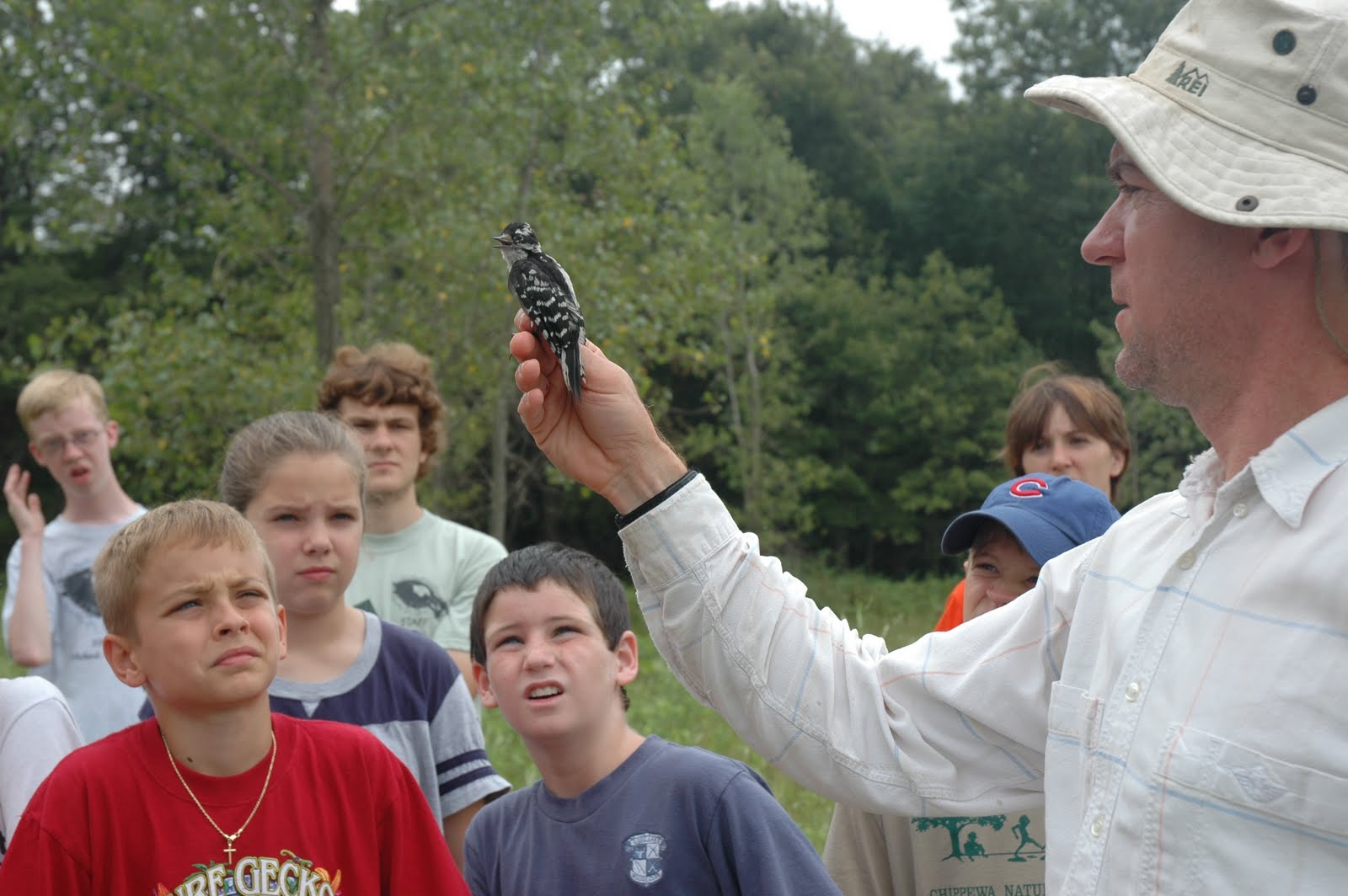
Bird Banding at CNC

A Common Yellowthroat warbler gets banded
at the CNC Wetlands Area. 
This year marks the 8th season of bird banding research at the Chippewa Nature Center Wetlands Area. The project is headed by Mike Bishop, professor of biology and ornithology at Alma College in Alma, Michigan. From year-to-year, the data he gathers gives us clues to the overall health of different species that live at CNC. Mike’s research follows the protocol of the national “MAPS” program (Monitoring Avian Productivity and Survivorship). A Nature Center staff member will also be on hand to help answer your questions and identify birds and other animals that are swimming in the ponds or flying by.
Mike Bishop demonstrates banding a
Downy Woodpecker to CNC Day Campers.

Visitors are welcome to observe banding from 8am-Noon on days which Mike is here banding birds. During this time, you'll hear facts such as the species, sex and age of the birds and have the opportunity to ask questions. Bring your camera, as you'll have excellent opportunities for photography!

For a full list of banding dates this year, check out our webpage calender here. If rain or windy weather is threating, please check the website, our Facebook page or give us a call for updated schedule information.

Monday, May 30, 2011

The Merry Month of May

May is a special time of year at Chippewa Nature Center. It is a month of rain showers and blooming flowers, young rabbits and new fawns, paddling trips and birding trips galore. We hope you enjoy these pictures of the season, all taken in the month of May at CNC. Remember, you don't have to travel to the depths of wilderness or to exotic mountain locations to be immersed in the beauty of our natural world. All you have to do is open your door and step outside! For a full list of upcoming programs at Chippewa Nature Center, visit our website calendar.

American Robin
Painted Turtles can be found on many Nature Center ponds.
This stylized photo is a Rusty Blackbird along the Chippewa River. 
Eastern Chipmunk with a full cheek!
Serviceberry Blossoms
White-tailed Deer resting in the woods
May Apple leaves in the Beech-Maple Woods
A young Great-horned Owl perched near the Homestead

Tuesday, May 17, 2011

Celebrate National Walk in the Woods Day!


This Saturday, May 21 is National Walk in the Woods Day. The American Forest Foundation is helping develop and facilitate a variety of U.S. celebrations for 2011 International Year of Forests throughout the year. This year, Saturday, May 21 is National Walk in the Woods Day, and we invite you to share this day with others. Consider helping youth and adults alike to discover a forest and learn about its importance by participating in, or leading, a “walk in the woods.”
 
Here are some ideas:
  • Discover your forest!  Visit a nearby woodland, city or state park, or a national forest.
  • If you own woodland, invite your family, neighbors, elected officials, or other members of your community to join you for a walk on your property.
  • Take your children, grandchildren, or family/friends/neighbors’ children for a walk in the woods. Conduct an informal educational activity, for example using Project Learning Tree’s “Connecting Kids to Nature” activity series.
  • Help a school improve its grounds by planting trees with students and teachers; involve a local youth club.
  • Go camping, or just step outside and enjoy trees and all that they give us!

For more information, click here to plan your National Walk in the Woods Day activity.

Monday, May 9, 2011

Leelanau BirdFest: June 1-5, 2011

Though many people are aware of the Traverse City area's fame for cherries, wineries, lighthouses and spectacular sand dunes, the first annual Leelanau BirdFest is another great reason to visit the area this spring. Held from June 1-5, the event promises to "offer a wide variety of unique field trips including Birding by Tallship, endangered Great Lakes Piping Plovers, a 300 acre prairie, and pontoon boat to the Leelanau Conservancy’s Cedar River Preserve.  Every field trip, seminar and keynote program reflects our conservation theme." 

The event is sponsored by a diverse group of organizations including the Leelanau Chamber of Commerce, Sleeping Bear Dunes National Lakeshore, Michigan Audubon Society, Leelanau County Parks and Recreation and many more.

Birding highlights in the area include nesting Piping Plover (a federally-listed endangered species), nesting Prairie Warblers, and a wide variety of field species, such as Grasshopper and Vesper Sparrows, in areas of preserved farmland. For more info, you can print a checklist of birds found at Sleeping Bear Dunes National Lakeshore by clicking here.

To find a full schedule of information and to register for the BirdFest, visit their website.

Monday, May 2, 2011

Choosing the Right Field Guide

Let's say you want to get started in birding so you head out to the local bookstore. With so many field guides out there, it can be a daunting task to figure out which one will work best for you outdoors! While choosing a field guide has a lot to do with personal preference, here are a few things to look for as you decide what’s right for you.

Narrow the focus
If you do most of your birding close to home, choose a guide that specializes on your area of the country. Books that cover all of North America can get confusing.

Pictures or drawings?
A photograph gives you a sample of a real-life bird in the wild, but drawings
may capture variations in plumage better.

Organization
A guide that presents bird species by family (ducks, warblers, etc.) is easier to use than
one that organizes birds by color or size.

Our top picks
Guides preferred by CNC staff are The Sibley’s Field Guide to Birds of Eastern North America by David Allen Sibley and Birds of Eastern and Central North America by Roger Tory Peterson.

You'll find a great selection of field guides right here at the Chippewa Nature Center store!

Monday, April 25, 2011

April Photo Sampler

Enjoy these pictures all taken in the month of April at Chippewa Nature Center. You can post your favorite photos taken at CNC on our Facebook page at www.facebook.com/cncmidland.

Canada Goose swimming in the Chippewa River

Wild Turkey Feather in the Arbury Woods

Flowers on a Basswood Tree

Red Maple Tree flowers
Opossum Hiding in the Brush

White-Tailed Deer Jumping in the Snow
White-Tailed Deer Peeking Through the Trees

Monday, April 18, 2011

Choosing the Right Binoculars


Spring is a great time of year to grab your camera or a  pair of binoculars and head outdoors to enjoy the natural beauty that is appearing all around us every day.

When choosing binoculars consider how well they fit your hands, eyes and of course, pocketbook. Numbers such as “8X42,” refer to the magnification (first number) and field of view (second number), or how much area can be seen. To choose the best ones for you, "field-test” binoculars indoors first by looking at small type on distant signs, items of similar color, and poorly-lit areas. Ask yourself “field” questions, such as: Do they fit your hands? Are they light enough to hold up to your eyes for a while? Can you focus quickly, and on something nearby, or only on distant objects?

There are many great articles and reviews online with expert advice to help you choose the best pair for your needs. For more information, check out this review at Bird Watcher's Digest or feel free to call a Chippewa Nature Center Naturalist at (989) 631-0830.

Monday, April 11, 2011

Naturally...

We've nearly run out of our first order of Blurb Books in the Chippewa Nature Center Store, but more are on the way! Get your autographed copy today for only $24.95 (members receive a 10% discount). Live far away? You can also pick it up in our Blurb Bookstore. For every copy sold online, Blurb donates and extra dollar to CNC! For an article about our book, including an interview with the author, check out Janet's Journals.


Monday, April 4, 2011

The Test Tube with David Suzuki


What would you do if you had an extra minute to spare? Check out this playful look at the serious subject of global overpopulation and food shortages in this interactive film project The Test Tube with David Suzuki.

Brought to you by the National Film Board of Canada, they describe the experience as follows: "Lasting just a few minutes,The Test Tube with David Suzuki takes a playful look at global overpopulation and food shortages. The visitor is “placed” in a test tube as a bacterium. It starts with a simple question: 'We know you’re busy, but if you could find an extra minute right now, what would you do?' Those who answer are addressed by the Canadian scientist and environmental activist David Suzuki. Since 1971, Suzuki has been dedicating himself to combating the consequences of climate change – in both his scientific work and his activities as a radio and television personality. While Suzuki explains his analogy of a test tube slowly filling with bacteria for our increasingly overpopulated planet, we see the screen gradually fill with digital bacteria. Clicking on individual bacteria reveals messages from other people who answered the initial question. It turns out we are not as unique as we might like to think."

The short film is a blend of animation and live action like you've likely not experienced before. Take some time to check it out along with the cool interactive features of the site. If you had an extra minute, what would you choose to do?


Monday, March 28, 2011

drive on the wild side

Bald Eagle
photo by Kim LeBlanc
STOP THE PRESSES!  The refuge just announced that the auto drive described below will NOT open April 15, because a pair of Bald Eagles are building a nest along the route.  If they continue to use that nest, it might be mid-June before the route opens.  But since eagles often build "practice" nests, the route might yet be opened in early May.  Stay tuned! 

The Shiawassee National Wildlife Refuge has over 9,000 acres, but most of it has been accessible only by foot or bike, or not at all (the better to maintain it as a "refuge" for wildlife!).  But this year that changes, as a 7.5-mile auto tour opens in April. (http://www.fws.gov/midwest/Shiawassee/)

The auto route will be open 7 a.m. - 7 p.m. from April 15 - October 5, barring flooding conditions or soft roads.  And since four rivers come together at Shiawassee, take that "except when flooding" clause seriously!  To be certain of conditions, it's a good idea to call the refuge headquarters, (989) 777-5930, ahead of time. Another complication could be one of the more popular critters at Shiawassee -- the Bald Eagle.  If eagles choose to nest alongside the driving route, the opening date would have to be postponed until the young eagles leave the nest.

The route will provide wonderful access to the forests, floodplains, wet meadows, cattail marshes and rivers of Shiawassee, and its incredibly diverse wildlife.  People driving the route will be asked to remain in their cars, except at designated viewing areas, in order to limit their impact on birds and other wildlife. (Cars make great wildlife blinds!)


Check out Janet Martineau's
blog for more information
on the auto route at Shiawassee
 For more information about the auto route, check out this blog by "Friends of the Shiawassee" member, Janet Martineau,  http://janetmartineau.blogspot.com/2011/01/shiawassee-national-wildlife-refuges-75.html.
If you haven't visited this refuge before, you are in for a treat!  Over 270 species of birds use the refuge, including thousands of waterfowl during spring and fall migrations.  The refuge has been designated as a U.S. Important Bird Area by the American Birding Association. Prothonotary warblers, rails, shorebirds, nesting Bald Eagles. . . every season brings a variety of sightings!


Monday, March 21, 2011

Help map the moon!

"Citizen Science" has long allowed amateur ornithologists, lepidopterists, herpetologists, and lots of other "ologists" to take part in monitoring populations of plants and animals here on Earth.  But now is your chance to reach beyond our planet by helping to map the moon! The Citizen Science Alliance needs lots of eyes to help classify tens of thousands of NASA's moon photos.  It's a daunting task for a handful of scientists, but with the help of hundreds (or thousands?) of the rest of us, the craters, boulders, fallen space debris and other features of the moonscape will be mapped in fine detail.

Participants are asked to simply sort through a variety of photographs and count the craters, look for other oddities, and compare the numbers of boulders strewn across different areas of the moon.  It's an exercise in pattern recognition and counting that is still best done by the good ole human eye rather than by computers!  To help out with this project, check out this website:   http://www.moonzoo.org/

Monday, March 14, 2011

More clues in deformed frog mystery

Deformed Leopard Frog
photo courtesy David Skelly/Yale University
Year-by-year, scientists are gathering more information about what is causing deformities and "intersex" (mix of male and female parts) conditions in frogs across North America.  As the clues come in, it becomes more and more obvious that the deformities are almost certainly due to agents humans are introducing into the environment.  

The most recent research, by Yale University's David Skelly, is further evidence that the deformities are not caused by a single culprit, but rather by a suite of estrogen-mimicking drugs, industrial chemicals and pesticides.  Skelly's research studied frog populations in the ponds of four different Connecticut ecosystems: forested landscapes, agricultural areas, suburbs and cities. Not surprisingly, the frogs of forested landscapes were perfectly normal. Those in some agricultural area ponds had deformities.  However, the rate of deformities in urban and suburban areas was THREE times the rate of deformities in agricultural areas!  “The fact that these kinds of estrogens out in the environment can have this kind of effect on a vertebrate — many people would say that that alone is a basis for us to be concerned,” Skelly says of the potential impact of his studies. 

Skelly says drugs that are meant to act as estrogen (though not intended for the environment!), such as birth control pills, along with unintentional estrogen mimics such as the plasticizer agent Bisphenol A (BPA), are not removed by standard wastewater treatment, so they pass easily from our homes and factories into nearby rivers, streams and ponds. For a more complete report of his findings, check out the Yale Environmental 360 website:  http://e360.yale.edu/feature/unraveling_the_mystery_of_the_bizarre_deformed_frogs/2368/

Monday, March 7, 2011

lights out!

Night, or what is left of it,
in North America.
From parking lots to ball diamonds to our own backyards, we have lit up our nights to the point that we don't really have "night" anymore.  Light seemed like a good idea back when we lived around campfires, but it turns out there really is too much of a good thing.  Our relunctance to deal with the dark has been proven to have a negative impact not just on backyard stargazers and professional astronomers, but on wildlife , and on our own health and safety.  From baby sea turtles crawling away from the ocean instead of into it (due to nearby town lights), to various cancers (due to a decrease in the production of melatonin when exposed to nighttime lights), to safety issues caused by outdoor lights that create glare rather than security, night sky pollution is a serious hazard!  For more information on this topic, and to learn how you can use light without reducing your safety or endangering your health or that of wildlife, check out the website of the International Dark Sky Association, http://www.darksky.org/.
Typical mercury "security"
light that provides
more glare than security.

This organization does not recommend simply turning lights off and living in the dark, but using lights WISELY -- as needed, where needed, and most importantly, with light fixtures that put light where it is needed, rather than shooting it off into the sky (or worse, into your eyes, which keeps you from seeing the very dangers you are trying to expose).  The "frequently asked questions" page is a good starting point. So as always, turn off lights where you can. But where you can't, use the right light.